

What Is a Sportsbook API? Line, Live, Settlement and Widgets Explained for Project Owners
A sportsbook API in plain words: its four parts, what a player sees from each, what stays on the owner's side, how it differs from an odds API and a turnkey platform, and what it costs to start.
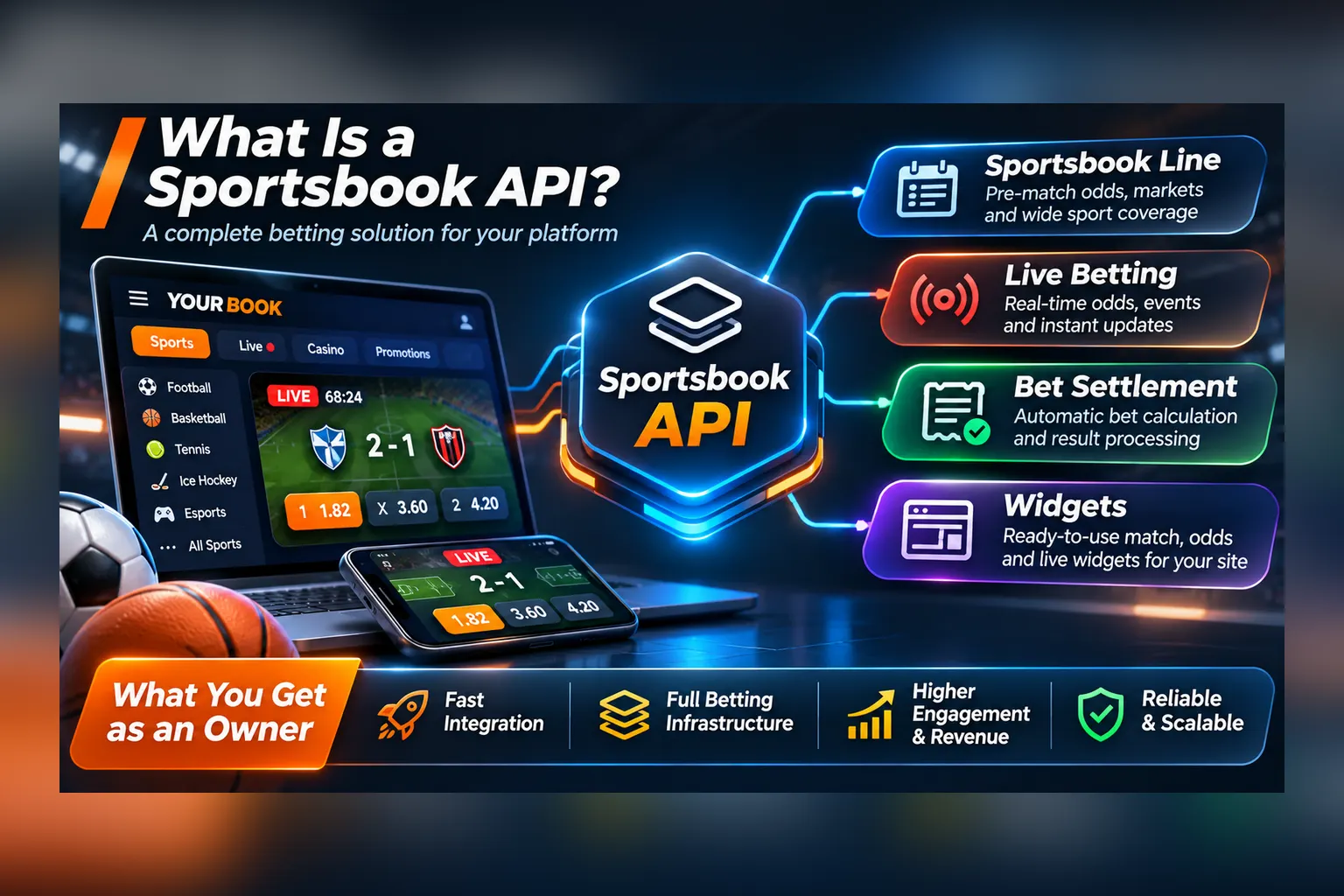
A sportsbook API is a service your site connects to in order to get what a bookmaker’s trading and data teams produce: the list of matches with odds, their updates during play, the acceptance of bets with a price check, and the result of every bet after the match. Your site keeps everything that makes it your business: the players, their money, the design and the brand.
In short, it has four parts: the line, live, bet acceptance with settlement, and ready interface blocks such as widgets and a match tracker. You can take one part or all four. With SportAPI the line starts from $30 a month per sport, bet acceptance and settlement from $300 a month, and a test key is free for two days.
This article explains each part without code, shows what stays on your side, and compares a sportsbook API with an odds API and a turnkey platform.
How a sportsbook API works, step by step
“API” means that your server asks another server a question and gets a structured answer. A player never sees it. This is the whole path of one bet:
- A player opens the football page on your site.
- Your server asks the API for today’s matches and odds and shows them in your design.
- The player picks an outcome and presses “Place bet”.
- Your server holds the stake on the player’s balance and sends the bet to the API.
- The API checks that the odds are still valid and accepts the bet, or returns the new price.
- The match ends. The API sends your server the result: won, lost or refunded.
- Your system pays the winnings to the player’s balance.
Steps 2, 5 and 6 are the API. Everything else is your product.
The four parts of a sportsbook API
| Part | What it does | What the player sees | From |
|---|---|---|---|
| Line (prematch) | Returns sports, tournaments, matches, markets and odds before the start | A schedule and a match page with odds | $30 a month per sport |
| Live | The same matches in play: score, clock, changing odds, blocked selections | An in-play page that updates itself | Included in the line plan |
| Bet acceptance and settlement | Checks the price, accepts the bet, settles it after the match and reports the result | An accepted bet slip and a payout | $300 a month |
| Ready interfaces | A sportsbook widget, a live match tracker, video, statistics | A finished betting section or a block on the page | Per product |
The line
The line is the catalogue: which sports and tournaments are available, which matches are scheduled, which markets each match has and at what odds. On 9 November 2026 the SportAPI prematch menu had 28 sports with scheduled events, from football, tennis and basketball to cricket and darts. One top football match has hundreds of selections; you decide how many to show. This part is the Sports Odds API.
Live
Live is the same data for matches in play, with a score, a clock and odds that change every few seconds. A selection can be blocked for a moment after a goal, and the site must remove the button for it. Your server asks for fresh data on a schedule, every 5 to 7 seconds, and serves all players from one copy.
Bet acceptance and settlement
This is what turns an odds site into a sportsbook. The Coupon API receives the bet from your server, compares the odds with the current ones, and accepts it or returns the new price. Singles and accumulators of up to 15 selections go through the same request. After the match it settles every selection, including handicaps with refunds and cancelled matches, and sends your server the final status and the payout amount. How that works is in Automated Bet Settlement.
Ready interfaces
If you don’t want to build the betting interface, the sportsbook widget puts a finished one into your existing page: events, markets, a bet slip. A live match tracker shows a match as a 2D or 3D scene, and video streams and a statistics widget are separate blocks. These are optional; the first three parts work without them.
What stays on your side
A sportsbook API doesn’t make you a licensed operator and doesn’t touch your players’ money. This is the split:
| The API does | You do |
|---|---|
| Supplies matches, markets and odds | Hold the licence and follow the rules of your market |
| Updates live data | Register players and verify their identity |
| Accepts bets with a price check | Keep balances, take deposits and pay withdrawals |
| Settles bets and reports results | Set limits, bonuses and risk rules |
| Provides ready interface blocks | Run support, marketing and the brand |
That’s why the stake is held in your system and only the bet itself goes to the API. Betting products are for licensed operators and adult players, and the rules differ by country.
Sportsbook API, odds API or turnkey platform
The terms overlap, so owners often compare different things.
| Term | What’s included | When it fits |
|---|---|---|
| Odds API, odds feed | Matches and odds, prematch and live | Odds sites, prediction products, widgets |
| Sportsbook API | Odds plus bet acceptance and settlement | You have a site with accounts and payments and add betting |
| Turnkey platform | All of the above plus accounts, back office and payment integrations | You start from zero and want one system |
| White label | A turnkey platform run under the provider’s licence | You want to launch a brand without your own licence |
A sportsbook API gives the most control and the lowest monthly cost, and it needs a developer. The comparison with a ready platform is in Turnkey Sportsbook vs Building on APIs.
What one request looks like
You don’t need to read code to buy an API, but one example removes the mystery. Your server sends a request with a key:
GET https://YOUR_API_DOMAIN/v1/events/1/0/sub/50/line/en
Package: YOUR_API_KEY
And gets matches in a structured format, shortened here to one market, with placeholder team names:
{
  "opp_1_name": "Home Team",
  "opp_2_name": "Away Team",
  "game_start": 1794268800,
  "game_oc_list": [
    {
      "group_name": "1x2",
      "oc_list": [
        { "oc_name": "W1", "oc_rate": 2.10, "oc_pointer": "..." },
        { "oc_name": "X", "oc_rate": 3.40, "oc_pointer": "..." },
        { "oc_name": "W2", "oc_rate": 3.60, "oc_pointer": "..." }
      ]
    }
  ]
}
oc_rate is the price, and oc_pointer is the identifier your server sends back when a player bets on that outcome. The API domain and the key come from the SportAPI manager; the first steps are in the quick start.
What it costs and how long it takes
| What you need | Cost |
|---|---|
| The line for one sport: prematch and live, markets and odds | from $30 a month |
| One extra language of the data | +$10 a month |
| Bet acceptance and automatic settlement | from $300 a month |
| Live match tracker | from $50 a month per sport |
| Testing before you pay | free two-day test key, all sports |
A site with football odds starts at $30 a month. A sportsbook with football bets starts at $330. There’s no connection fee.
Time depends on who builds it. One developer needs about four working days for the line and about seven for the line, bets and settlement; the plan is in Sportsbook API Integration in 7 Days. The widget is faster because the interface is ready.
What to decide before you connect
- Which sports. Plans are per sport. Start with the ones your players open.
- Your interface or the widget. Your own front end gives full control and takes developer time.
- Odds only or bets too. A prediction or odds site needs only the line.
- Who builds it. A developer, an agency, or the provider’s team for a separate fee.
Mistakes owners make
- Expecting a licence or payments from an API. Those are yours. An API supplies data and handles bets.
- Letting the browser call the API. That exposes the key. Requests go through your server.
- Building settlement in-house. It looks simple until the first cancelled match and quarter handicap.
- Buying every sport at once. Start with one and add sports when players ask.
- Skipping the test. Two free days are enough to see the data on your own pages.
FAQ
Is a sportsbook API the same as an odds API?
No. An odds API returns matches and prices. A sportsbook API also accepts bets and settles them. With SportAPI these are two services you can take separately.
Do I need a licence to use a sportsbook API?
To take bets from players, yes: licensing is the operator’s responsibility and depends on the country. To show odds or predictions without taking bets, the rules are different; check them for your market.
Who holds the players’ money?
You do. Balances, deposits and withdrawals stay in your system. The API receives the bet and returns its status.
Can I launch without a developer?
The API route needs a developer, because the key and bet handling must live on a server. Without one, use the sportsbook widget or order the integration.
How fast do live odds update?
Your server polls live data every 5 to 7 seconds and shows it to all players from one copy. Polling more often doesn’t make the data fresher.
Can I start with the line and add bets later?
Yes. The line and the bet service are separate. Many projects launch as an odds site and add betting when the audience is there.
Start with a two-day test
The fastest way to understand a sportsbook API is to see your own page filled with real matches. Ask the SportAPI manager on Telegram for the API domain and a test key, name the sports you need, and check the line on your site before you pay for anything.