

How to Make a Sports Betting App for Android and iOS: What It Takes and What It Costs
The parts of a sports betting app, what Apple and Google require, how a bet travels from the button to settlement, and where the development budget goes.
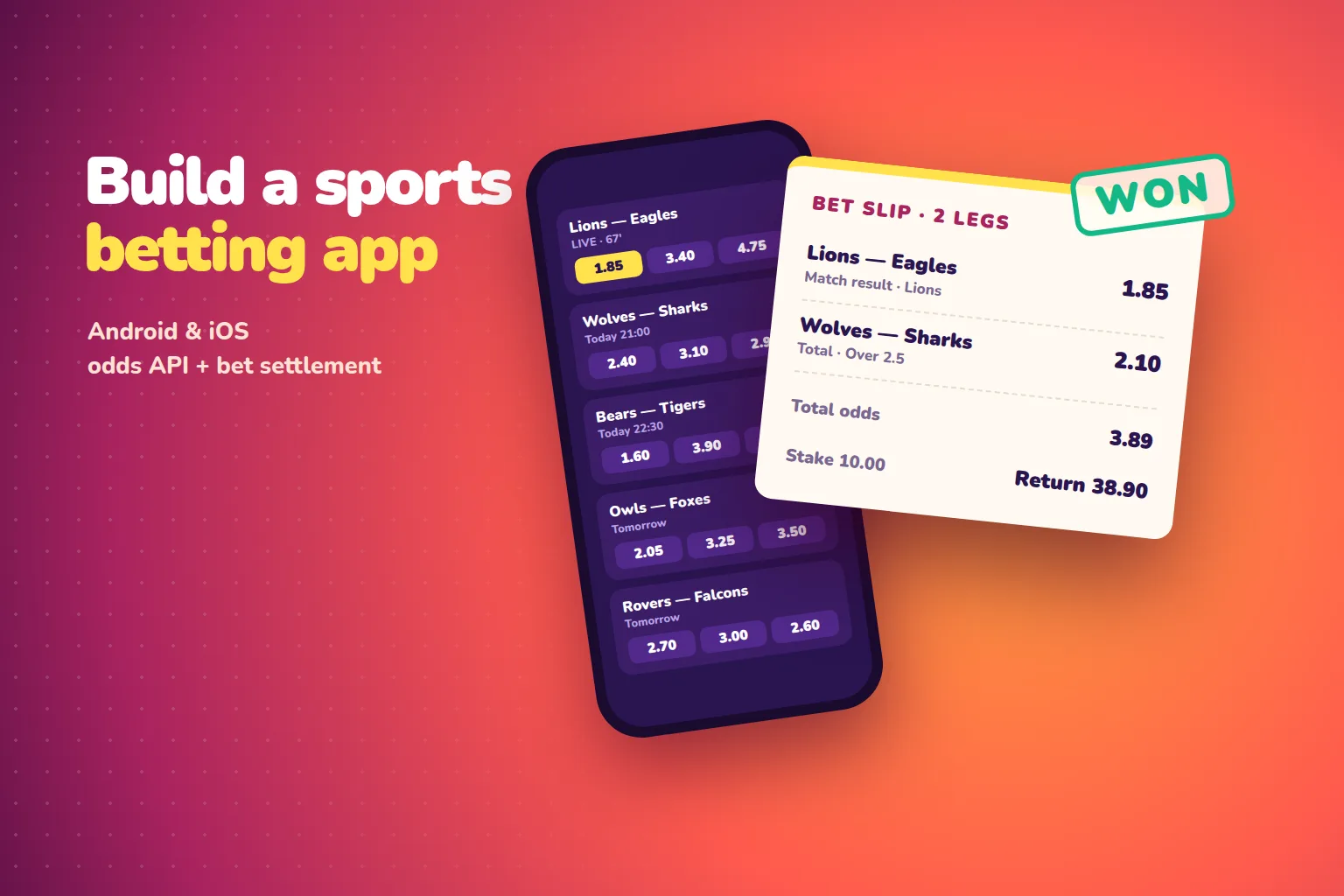
Behind the odds screen of a sports betting app sit five parts: the sports line and live data, the bet slip, bet acceptance and settlement, the player wallet with payments, and the operator’s back office. Leave any one of them out and the app can’t take a single bet.
You don’t have to build two of the five from scratch. Matches, markets and odds for prematch and live come from the SportAPI sports odds API, from $30 a month per sport. Bet acceptance, odds validation and settlement are handled by the Coupon API, from $300 a month. The wallet, payments, player verification and the licence stay with the operator. Below: what exactly you need to build, what Apple and Google require, and where the sports betting app development budget goes.
The parts of a sports betting app
| Part | What it does | Where it comes from |
|---|---|---|
| Line and live | Sports, competitions, matches, markets, odds, score and match clock | Sports odds API |
| Bet slip | The player builds a single or an accumulator and sees the potential return | Your app UI + line data |
| Bet acceptance and settlement | Checks the odds at the moment of the bet, creates the coupon, settles it as won, lost or void | Coupon API |
| Wallet and payments | Player balance, deposits, withdrawals | Your system and payment providers |
| Accounts and checks | Sign-up, age and identity checks, responsible gambling limits | Your system and verification providers |
| Back office | Users, bets, reports, settings | Your system |
One boundary matters: player money stays in the operator’s system. The Coupon API deals with bets and their settlement; balances, deposits and withdrawals are run by your server.
What Apple and Google require
You can’t just build a real-money betting app and upload it. As of October 2026 the rules are as follows.
App Store (Apple App Review Guidelines, section 5.3.4):
- the app must have the necessary licences and permissions wherever it is used;
- it must be geo-restricted to those locations;
- it must be free on the App Store, and in-app purchase can’t be used to buy credit for real money gaming (section 5.3.3);
- gambling apps should be submitted by the legal entity that provides the service, not an individual developer (section 5.1.1).
Google Play (real-money gambling policy):
- you complete a separate application and prove you are a licensed operator before distribution;
- you need a licence for each country, state or territory where the app is distributed;
- the app blocks under-age users and anyone outside the licensed area;
- the app is free to install and doesn’t use Google Play billing for gambling;
- it carries an Adults Only rating, and responsible gambling information is visible in the app and on the store listing.
The practical takeaway: get the licence and the operating company in place before the app is finished. Until then you can show the app to investors and testers, but not publish it. Advertising and gambling rules differ between countries, so check them for your audience.
A native app or a widget inside the app
There are two ways to build the betting interface.
| Your own app on the API | Sportsbook widget inside the app | |
|---|---|---|
| How it works | Line, live and bet slip screens live in your app code; data comes from the API through your server | A ready-made betting interface opens inside the app in a WebView |
| Time to launch | Longer: you build the screens | Shorter: the interface already exists |
| Look and feel | Entirely yours | Customisable within the widget |
| App Store review | A regular app | Risk under section 4.2: Apple rejects apps that feel like a repackaged website |
| Best for | Products built for the long run | Testing an idea quickly, a website with an existing audience |
We recommend the first route. An app built on the API is faster, feels native on Android and iPhone, and has an easier time in Apple’s review. The sportsbook widget is a good fit when you need betting on a website quickly or want to test demand before building native screens.
You can write the app in Kotlin and Swift separately, or use one codebase for both platforms with Flutter or React Native. We showed how to build a live matches screen on SportAPI data in our guide to a live scores app in Flutter.
Architecture: the app, your server and SportAPI
The app never talks to SportAPI directly. The API key and the Coupon API login live only on your server; otherwise anyone who unpacks the install file can take them.
- Your server fetches live matches every 7 seconds and prematch every 30 seconds with
events, caches them and serves them to the app. - When a player opens a match, the server requests the details with
event: all markets, statistics, the score. - The player picks an outcome. Each outcome in the line data has a technical
oc_pointer; together with the current odds it forms the bet pointer, as described in the bet pointer documentation. - The player taps “Place bet”. Your server checks the balance in its own wallet, reserves the stake and sends the coupon to the Coupon API.
- The Coupon API checks that the odds are still current and either creates the coupon or returns an error.
- After the match the Coupon API settles the coupon and posts the result to your callback URL. Your server pays out the winnings or releases the reserve.
Here is the bet handler on the server (Node.js):
// POST /api/bets: the app calls it when a player taps "Place bet"
app.post('/api/bets', requireUser, async (req, res) => {
  const { pointer, amount } = req.body; // pointer built from the line data
  await wallet.reserve(req.user.id, amount); // the player's balance lives in your system

  const response = await fetch(`${COUPON_API}/api/partner/coupons/place`, {
    method: 'POST',
    headers: {
      Authorization: `Bearer ${await couponToken()}`,
      'Content-Type': 'application/json',
    },
    body: JSON.stringify({
      list_bets: [pointer],
      amount,
      lang: 'en',
      mode: 'reject', // odds changed: don't accept the bet silently
      callback_url: 'https://api.your-app.example/coupon-result',
    }),
  });
  const data = await response.json();

  if (!response.ok || data.code !== 1) {
    await wallet.release(req.user.id, amount);
    return res.status(409).json({ error: data.error_code }); // 501: the odds have changed
  }

  const coupon = data.body.coupons[0];
  await bets.save(req.user.id, coupon.coupon_code, coupon.potential_win);
  res.json({ coupon: coupon.coupon_code, odds: coupon.coef });
});
Store coupon_code as a string: it has 12 digits and can start with zeros.
How a bet travels from the button to settlement
In live, odds change every few seconds, so the key question for any betting app is what happens when the odds move while the player is tapping the button. The Coupon API lets you choose:
| Setting | What happens |
|---|---|
mode: 'reject' | The bet is refused and the app shows the new odds |
mode: 'accept', mode_type: 1 | The bet is accepted only if the odds went up |
mode: 'accept', mode_type: 3 | The bet is accepted on any change |
Apps usually give players an “accept odds changes” toggle in settings and default to reject.
Errors you should explain to the player in plain words:
501: the odds have changed; show the new price and offer to bet again;502: the outcome is no longer available; remove it from the slip;503: the outcome is temporarily suspended, for example during a dangerous attack;506: an accumulator has two bets on the same match; keep one.
If you get 504 or an internal error, don’t treat the coupon as created and don’t blindly resend it. Check first whether the coupon exists, or the player ends up with two identical bets.
After the match the coupon gets a final status: 2 for won, 4 for lost, 8 for a full refund. The result arrives at your callback URL, and if your server was down you can request it by coupon code. An accumulator can hold up to 15 events. We covered the difference between singles and accumulators, and how returns are calculated, in our article on single vs accumulator bets.
How sports betting apps make money
A bookmaker’s main income is the margin built into the odds. If both “yes” and “no” are priced at 1.90, the implied probabilities add up to 1/1.90 + 1/1.90 ≈ 105.3%. The extra 5.3% is the margin: across many bets it stays with the operator, whoever wins an individual match.
So income depends on turnover, not on any single match: the more bets, the steadier the result. That’s why apps put so much effort into live betting, where most bets are placed, and into accumulators, where the margins of each leg multiply. Bringing players back matters too: a push when a favourite team kicks off, a fast bet slip and a clear message when odds change all lead to repeat bets.
Not every sports app takes bets. Apps with predictions, live scores and odds earn from ads, subscriptions and bookmaker affiliate programmes where that’s allowed. They don’t accept bets, and their data is the same SportAPI line.
What drives sports betting app development cost
Nobody can give you an honest single number: it depends on the team, the country, the number of platforms and the regulator. The cost lines, though, are the same for everyone:
| Cost line | What it depends on |
|---|---|
| Licence and operating company | Country or region, licence type |
| Design and the mobile app | One codebase or two, number of screens, animation |
| Server, wallet and back office | Number of payment methods, reports, staff roles |
| Player verification and responsible gambling | Regulator requirements, verification provider |
| Sports data | Number of sports: from $30 a month each with SportAPI |
| Bet acceptance and settlement | Bet volume: Coupon API from $300 a month |
| Support and updates | Release frequency, store requirements |
Most of the budget usually goes on the licence, the app, and the wallet with payments. Data and settlement, bought as ready services, are a noticeably smaller share, and you don’t need your own team of traders and settlement staff.
Mistakes when building a betting app
- API keys inside the app. They can be pulled out of the install file in minutes.
- No licence. The app won’t be published on the App Store or Google Play.
- A website in a wrapper instead of an app. Apple can reject it as a repackaged website.
- Silently accepting new odds. The player bet at 2.10 and the bet went through at 1.85: a sure way to get complaints.
- Resending a coupon after an error. Without a check, you get duplicate bets.
- No wallet of your own. The Coupon API doesn’t hold player balances, so deposits, stake reserves and payouts must be in your system from day one.
Building the data and betting layer on SportAPI
For a betting app SportAPI covers two ready parts:
- the sports odds API: 322 sports, prematch and live, markets and odds, score, clock and short live statistics, team logos; no monthly request quota as long as you keep to the recommended intervals;
- the Coupon API: singles and accumulators with odds validation, coupon statuses, settlement after the match and result callbacks to your server.
Honest limits: data is delivered over REST, and WebSocket support is in development. Cash out is in development too and isn’t used in production projects yet.
If you’d like to test the idea before building an app, you can launch betting inside a messenger. See our guide to a sportsbook in a Telegram Mini App.
How much it costs
| What you need | Price |
|---|---|
| Line and live for one sport: matches, odds, short live statistics | from $30 a month |
| Bet acceptance and settlement (Coupon API) | from $300 a month |
| Testing before you pay | A 2-day trial key for the line, all sports |
FAQ
Can I publish a betting app without a licence?
No. Both Apple and Google require a licence wherever the app is used and geo-restriction to those areas. Apps with predictions, live scores and odds that don’t accept bets aren’t covered by these rules.
How long does development take?
It depends on the team and the scope. Ready-made data and settlement save the hardest part: you don’t have to build a line, manage odds or settle thousands of markets. What’s left is the app, the server with the wallet, and integrations.
Can I build one app for iPhone and Android?
Yes. Flutter and React Native give you one app for both platforms. The server and the SportAPI integration don’t depend on the framework you choose.
Where are player balances stored?
In your system. The Coupon API handles bets and their settlement; deposits, withdrawals and player balances are run by your server together with payment providers.
What happens if the odds change as the bet is placed?
You decide. A sensible default is to refuse the bet and show the new odds, and accept changes only if the player has turned that on in settings.
Can I test the data before paying?
Yes. The 2-day trial key for the line includes all sports, prematch and live. Ask the manager about testing terms for the Coupon API.
What to do before development starts
- Pick your country or region and find out which licence you need.
- Decide between your own app on the API and a widget for a fast start.
- Map the bet flow: wallet, stake reserve, error handling, payouts.
- Get a trial key and build the first live matches screen.
Tell the SportAPI manager on Telegram you’re building a betting app. You’ll get a trial key for SportAPI odds and live data and the terms for connecting the Coupon API.